The Material Ghost in the Machine: Why are we buying physical records like vinyl or CDs again? (2016-2031)
For years, the story of music seemed obvious. Physical formats were fading away, streaming had won, and the future would be lighter, faster, and entirely digital.
That story was not wrong. But it was incomplete.
Over the last few years, something interesting has happened. Even in a world where almost every song ever made can be accessed instantly, people are still buying vinyl, CDs, cassettes, and even older formats. At first this looked like nostalgia, or perhaps a niche hobby for collectors. But it now feels like something larger: a cultural response to life in an increasingly dematerialised world.
What looks like a simple consumer trend may actually tell us something important about how people now want to relate to music, technology, memory, and themselves.
This is not only a story about records. It is also a story about ownership, identity, ritual, and the limits of convenience.
From ownership to access
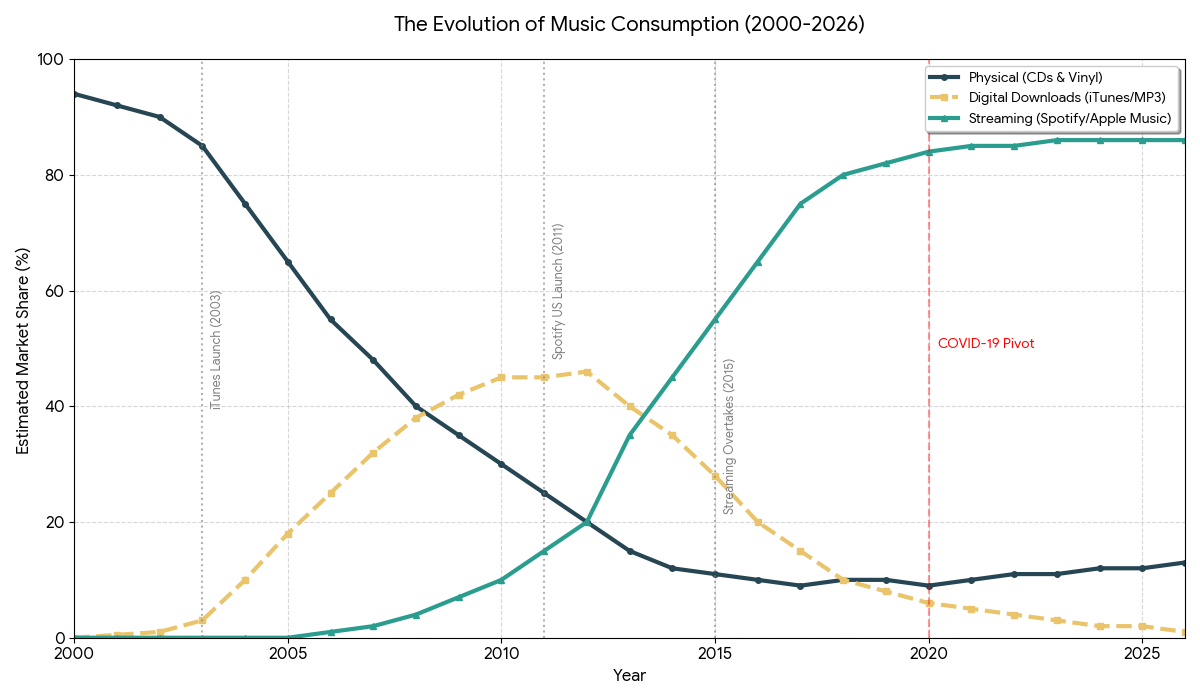
RIAA (Recording Industry Association of America), U.S. Sales Database 2005-2025.
The digital turn changed the music industry with extraordinary speed. In the space of little more than a decade, music moved from shelves and booklets to files, platforms, and subscriptions. The CD player was replaced by the smartphone. The collection in the bedroom became a monthly fee and an internet connection.
At the time, this shift felt progressive and inevitable. Digital access appeared more democratic, more efficient, and less wasteful. Why own a shelf of discs when you could have almost everything in your pocket?
But convenience came with a quieter loss. When music became frictionless, it also became less anchored. It stopped being something many people built a relationship with through objects, space, and repetition, and became something far more fluid: available everywhere, but often held nowhere.
Streaming solved many practical problems. It did not solve the human need for attachment.
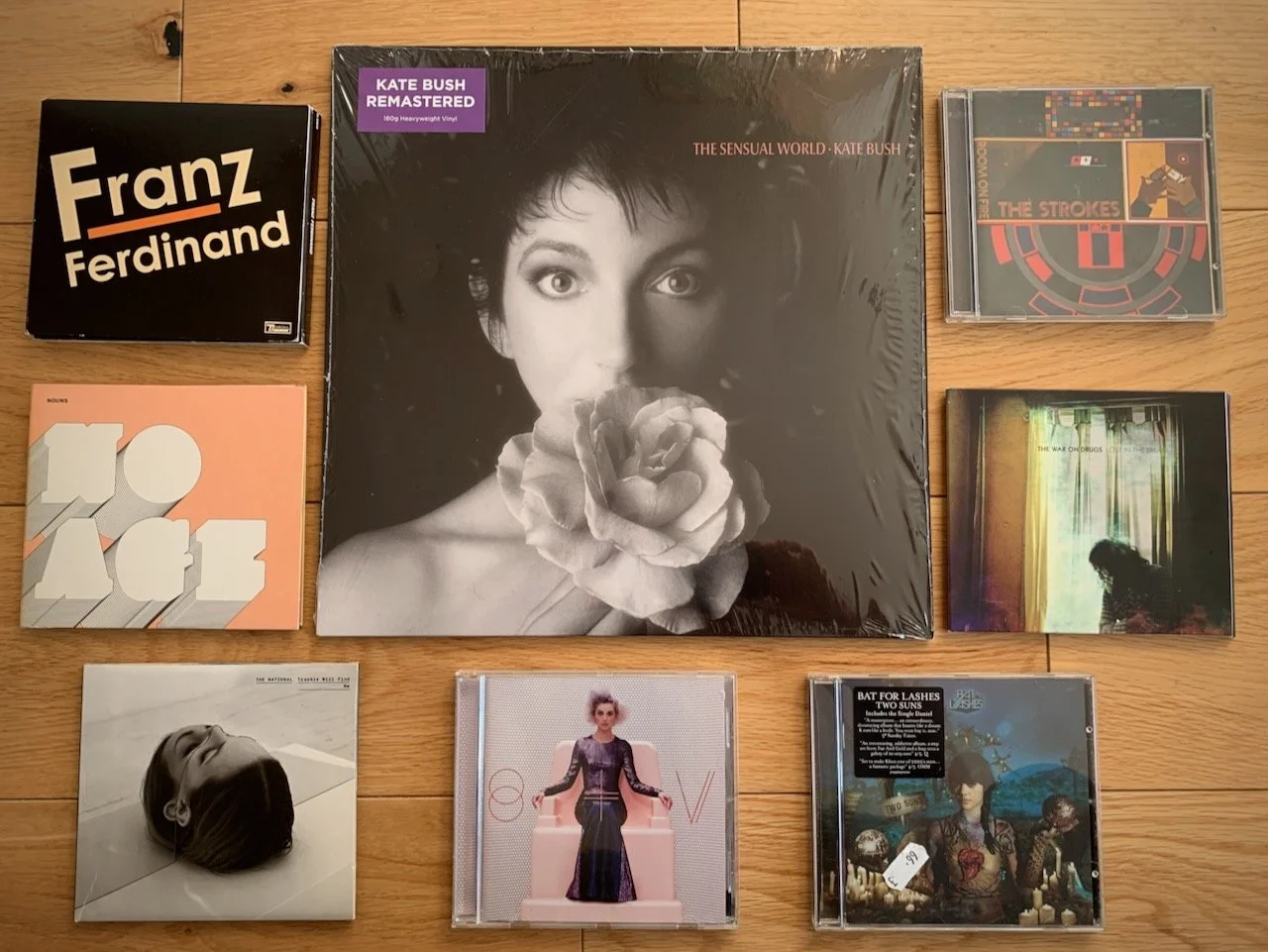
My own recent purchase at a record shop in London.
The return of the object
By the mid 2010s, physical music seemed to be in terminal decline. Yet the story did not end there. Vinyl began to recover. CDs, while treated as yesterday's technology, proved far more resilient than many expected. Used physical media kept circulating through charity shops, second-hand marketplaces, record fairs, and online communities. What had supposedly become obsolete never fully disappeared.
Part of the explanation is economic. Some people still want an affordable way to build a music library they actually own. Part of it is aesthetic. Album art, liner notes, sleeves, and packaging still matter. But the deeper explanation, I think, is sociological.
Physical music gives form to taste.
A playlist can be forgotten, edited by an algorithm, or buried in an app. A shelf of records is different. It sits in space. It becomes part of a room, a biography, a visible history of attachments. It tells a story not only about what someone likes, but about what they decided was worth keeping.
In that sense, physical media does something streaming rarely does: it stabilises identity.
Digital abundance, emotional thinness
One of the paradoxes of digital life is that more access does not always produce more meaning.
We now live in an age of almost unlimited availability. Music is abundant, immediate, and endlessly recommended. Yet this abundance can also flatten experience. When everything is always there, it can become harder for anything to feel chosen, kept, or earned.
Physical formats reintroduce a small but important amount of friction. You have to go and buy the album. You have to carry it home. You have to decide where it belongs. You may sit with it for longer. You may listen to the whole thing rather than skip after thirty seconds. You may remember where you bought it, who you were with, and why that record mattered to you at that moment.
That friction is not a defect. It is part of the meaning.
In a culture organised around speed and optimisation, the ritual of physical listening can feel almost oppositional. It asks for attention. It rewards slowness. It turns music from background stream into event.
Why younger people are buying old formats
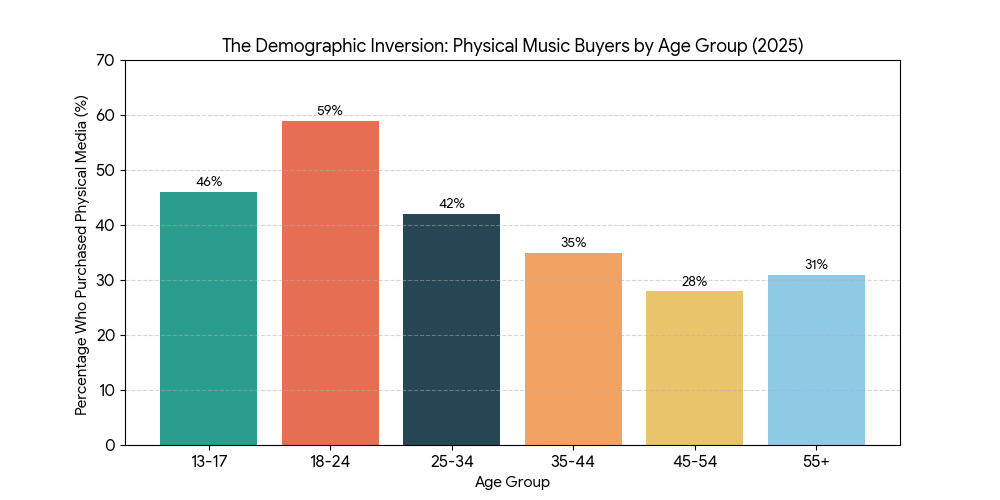
Source: ERA (Entertainment Retailers Association), Consumer Habits and the Physical Renaissance 2024-2025.
One of the most striking aspects of the revival of vinyl and CDs is that it is not only being driven by older generations. Many younger consumers, driven by Gen Z (ages 18 to 27 in 2026) and even Gen Alpha, people who grew up entirely inside digital platforms, are also buying physical music.
That matters.
Conventional market logic would suggest that physical music should mainly survive through habit among older consumers. Instead, younger buyers are helping keep it alive. This suggests that physical formats are not simply leftovers from a previous era. They are being actively reinterpreted.
Why might this be happening?
One reason is autonomy. Streaming gives access, but not control in any lasting sense. Digital libraries are licensed rather than owned, shaped by subscription models, platform interfaces, recommendation systems, and catalogue changes. Physical media offers something much simpler and more final: possession.
Another reason is self-definition. In algorithmic environments, taste is constantly nudged, predicted, and organised for us. Buying a record can become a small act of refusal. It says: this is mine, I chose it, and I want it to have a durable place in my life.
There is also the appeal of ritual. For a generation raised on endless scroll, the deliberate act of playing an album from beginning to end may carry a particular value. The object slows time down.
The pandemic and the domestic turn
Source: IFPI (International Federation of the Phonographic Industry), Global Music Report 2025.
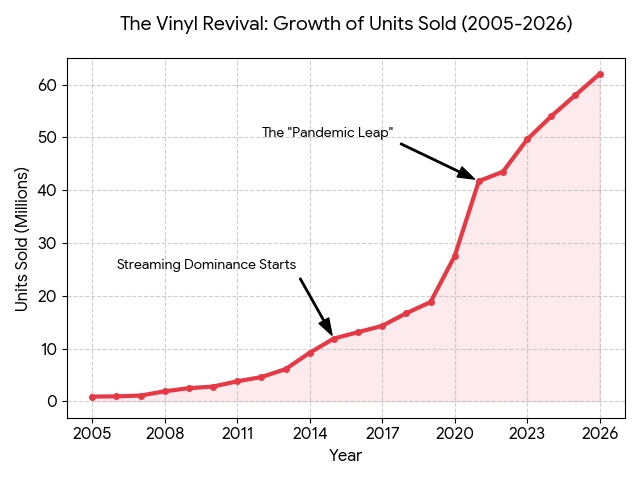
The Covid years intensified many of these dynamics.
When daily life contracted into the home, people were forced into a more domestic, interior relationship with culture. Screens became the site of work, friendship, entertainment, and exhaustion all at once. Under those conditions, the appeal of physical media became easier to understand.
Records and CDs offered not just music, but texture. They gave shape to time indoors. They made private space feel curated rather than simply occupied. They turned shelves, corners, and living rooms into small personal archives.
I do not think the pandemic created the revival of physical music on its own. But it seems to have accelerated tendencies that were already present: digital fatigue, the desire for tangible surroundings, and the need to make home feel meaningful.
In that sense, physical music became part of a wider return to material anchors.
Three different physical economies
The market for physical music is no longer one single world. It is increasingly divided into at least two different cultural economies, each with its own logic.
The first is a fandom economy, especially visible in global pop and K-pop. Here, the physical album is not always bought mainly for listening. It often functions as a collectible object, a display of loyalty, and a material expression of belonging. Multiple editions, alternate covers, bonus tracks, inserts, and limited variants turn the album into something closer to a token of participation. Buying it is not just a way of accessing music. It is a way of making attachment visible.
Artists such as Taylor Swift have understood this extremely well. The album becomes more than a format. It becomes a designed object within a broader emotional and commercial ecosystem, where collecting is part of fandom itself.
The second is a heritage economy, especially visible in the second-hand market for rock, grunge, alternative, Britpop, metal, and other historically anchored genres. Here, the attraction is often different. Buyers search for original pressings, older editions, or used copies not only because they want the music, but because they want a more tangible relationship to the period that produced it.
This is one reason artists such as Nirvana, Oasis, or Radiohead continue to circulate so strongly in physical form. For some buyers, especially younger ones, these objects offer a way of reaching towards an era that now feels culturally distant: a world before platforms fully organised taste, before recommendation systems became so central, and before so much of everyday life passed through the same few screens.
In that sense, people are not only buying 1990s music. They may also be buying contact with what feels like one of the last broadly remembered analogue cultural moments.
A third important economy can be seen in independent music scenes, where buying physical formats often means something more than collecting or nostalgia. Here, vinyl, CDs, cassettes, and small-run editions are frequently bought as acts of support, especially in the epoch of dominance of streaming. The object helps sustain artists, labels, shops, venues, and micro-scenes that exist outside the mainstream superstar system. To buy the album is not only to acquire music, but to help keep a cultural world alive.
This has been especially visible since the mid-2000s, in indie, DIY, experimental, punk, and Bandcamp-oriented cultures for artists like The Strokes, Yeah Yeah Yeahs, Tame Impala, Alvvays, St. Vincent, Grimes, but also older indies who continue producing (such as Nick Cave, Weezer, or Aphex Twin). In these spaces, physical media often carries an ethical as well as aesthetic value. It signals care, curation, and a desire for a more direct relationship between artist and listener. In a cultural environment shaped increasingly by platforms, metrics, and algorithmic visibility, the physical release can represent something more human in scale: a way of participating in music as a scene, not just consuming it as content.
These three economies matter because they show that physical formats now carry different meanings in different contexts. In one case, the object expresses present-tense allegiance. In the other, it offers a route into memory, history, and cultural atmosphere. But in both cases, the physical album still does something streaming alone cannot do.
It gives attachment a form.
The record shop as social space
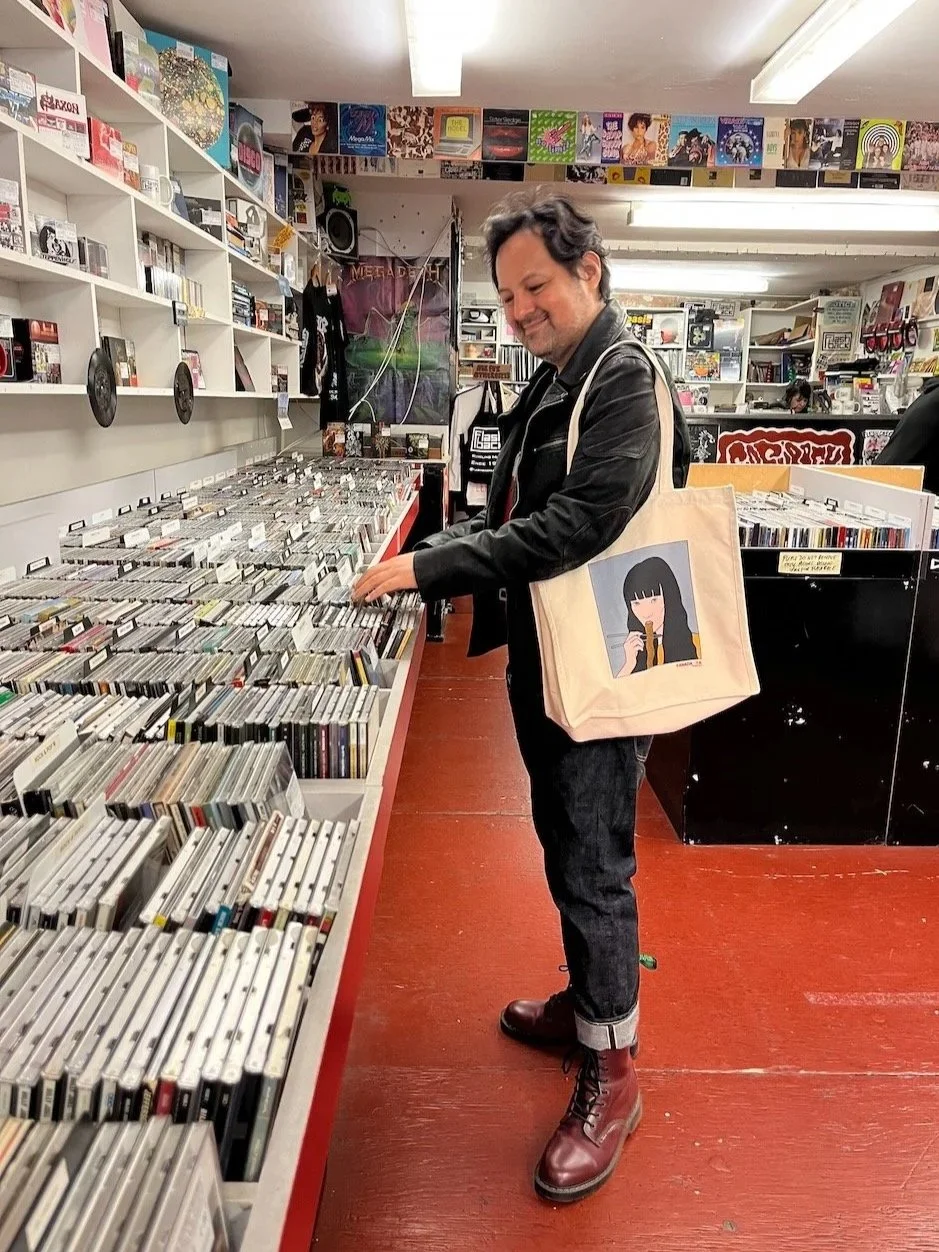
Myself looking through used CDs at a record shop in Shoreditch, London
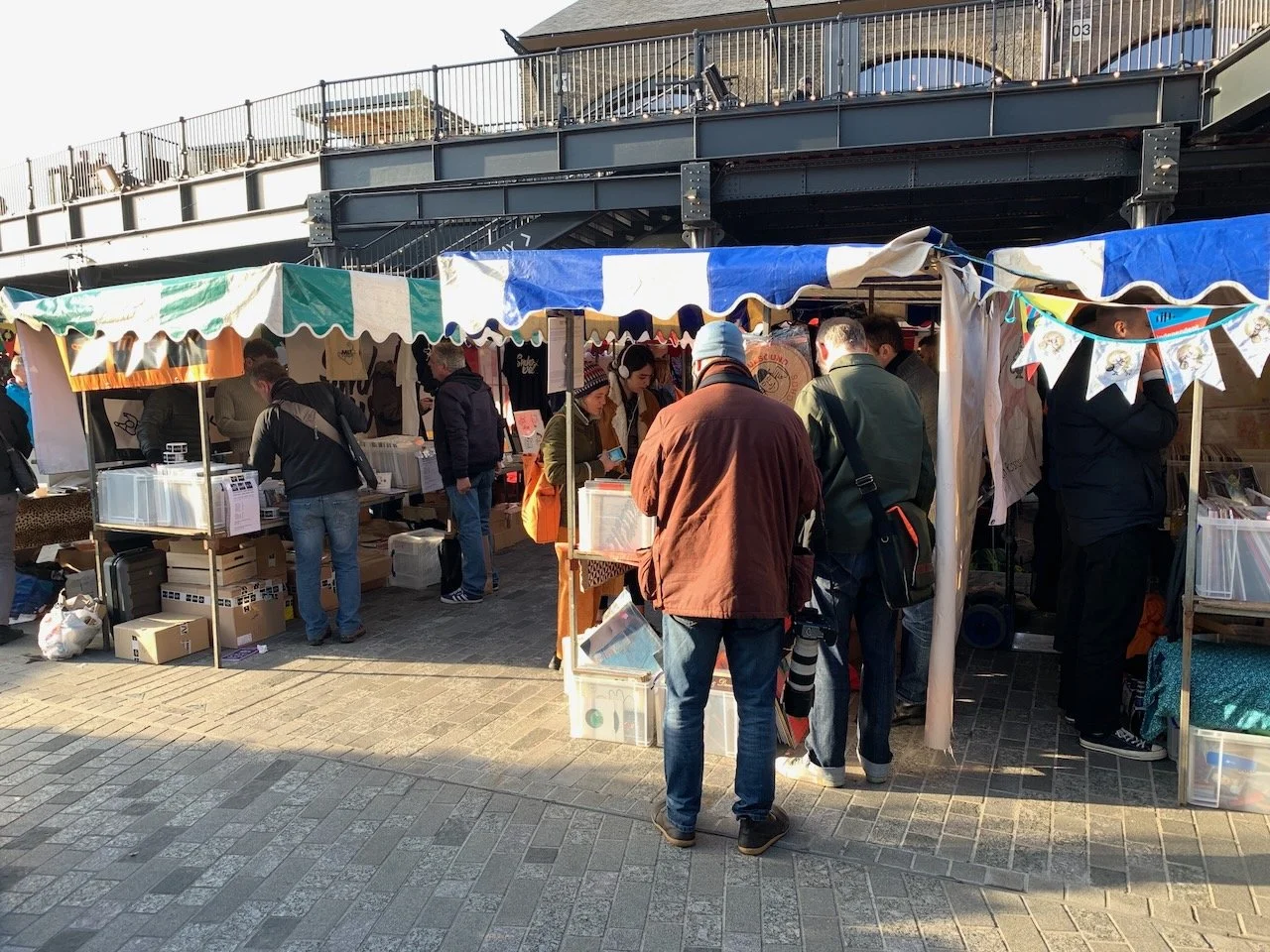
Record festival at Coal Drops, London
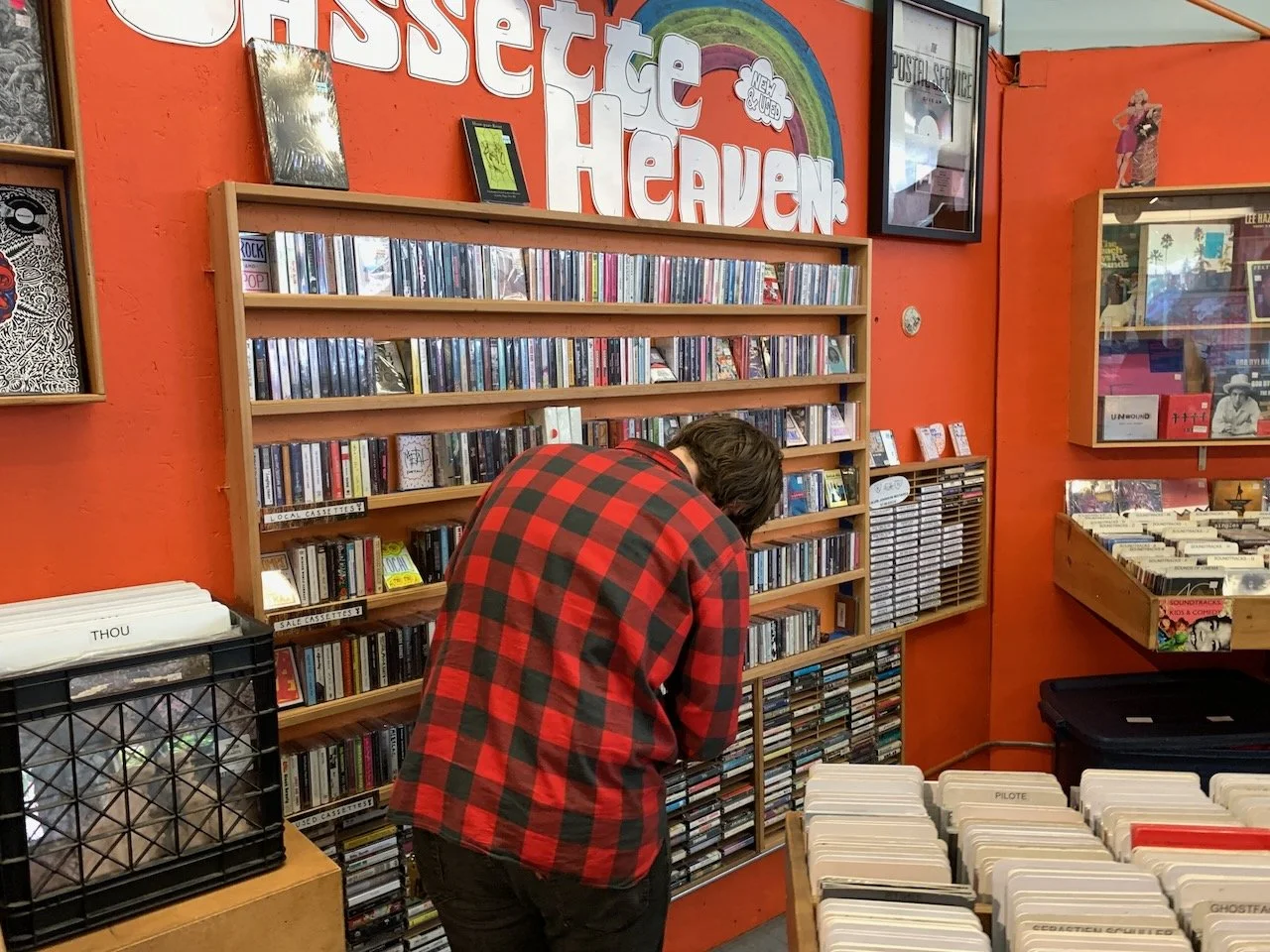
Cassettes buyer in Seattle
Physical music also survives because it is tied to places.
Independent record shops remain important not only because they sell objects, but because they produce a kind of social experience that digital platforms cannot fully replicate. They are spaces of browsing, conversation, accident, and recommendation. You go in looking for one thing and leave with another. You overhear a view. You ask a question. You notice what is on the wall. Someone else is flipping through the same section.
This is a very different logic from platform recommendation. Online systems are designed for relevance and efficiency. Record shops often work through chance, atmosphere, and human mediation.
At a time when so much retail has become standardised, frictionless, and lonely, this matters. The record shop remains one of the few places where cultural consumption can still feel public, situated, and social.
For anyone interested in cities, high streets, or urban culture, that should not be underestimated.
Vinyl prestige, CD democracy
Vinyl has become the visible symbol of the physical revival, but it is not the whole story.
The CD remains underestimated. It may not have the visual glamour of vinyl, but it still offers something powerful: affordability, portability, and scale. For many people, especially those buying second-hand, CDs make it possible to build a large personal music library at relatively low cost (in 2026 new vinyl albums cost is about £40 whilst used CDs cost between £0.5 to £7, or new ones between £7 to £12).
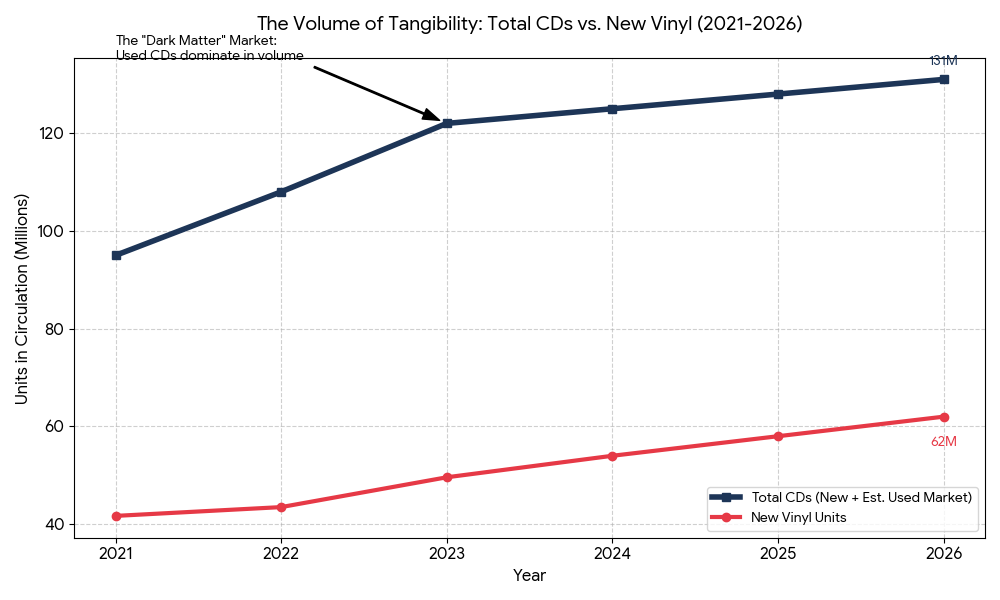
Source: RIAA (Recording Industry Association of America), U.S. Sales Database 2005-2025.
That gives the CD a different sociological role. If vinyl often functions as a premium object, the CD can function more like an everyday cultural tool. It allows ownership without luxury prices. It circulates widely through second-hand infrastructures. It makes collecting accessible.
In that sense, the CD may be less fashionable, but in some ways more democratic.
The current physical revival is therefore not just about prestige formats. It is also about access to material ownership at different price levels.
Why buying a record still feels satisfying
There is also a more intimate explanation for all this: physical music is emotionally satisfying in ways that digital music often is not.
A record or CD gives sensory feedback. The weight of it, the sleeve, the case, the booklet, the sound of opening and closing, the act of placing it somewhere. These are small gestures, but they matter. They make music feel embodied.
They also help anchor memory. People often remember where they bought a record, what stage of life they were in, what the album meant to them, and what they hoped it would become in their lives. The object absorbs biography.
Physical music also reassures because it endures. In a world where so much culture is rented, updated, removed, or buried under new content, the disc remains stubbornly there. It can age with you. It can be found years later. It can be moved from one home to another. It can be lent, inherited, sold, or rediscovered.
That kind of continuity should not be dismissed as sentimentality. It answers a real need.
Looking ahead: 2026-2031
I do not think physical music will replace streaming. Streaming has clearly won as the dominant way most people listen most of the time. But I do think physical formats will continue to matter, and perhaps even gain a stronger symbolic role over the next five years.
As a sociologist and future-looking strategist, I think three possibilities seem especially plausible for music lovers.
First (around 2027), physical music may become more valuable as proof of human intention. In an era increasingly shaped by AI-generated content, automation, and synthetic abundance, the designed, printed, manufactured album may carry greater weight as a human-made cultural object.
Second (2028), audio hardware may become more culturally expressive. Turntables, CD players, portable devices (not only cassettes of minidiscs, but also digital to ‘analog players’ such as iPods), and carefully chosen sound systems may increasingly function not just as utilities, but as visible statements of taste and seriousness, and a sense of privacy (AI or other connected products to know music lovers’ preferences).
Third (around 2031), the rise of spaces for deep listening. A further possibility is that physical music will matter not only as an object, but as the centre of a different kind of domestic space.
As homes become more saturated with connected devices, voice assistants, screens, notifications, and invisible forms of tracking, many people may begin to feel that convenience has gone too far. In such environments, music risks becoming ever more available and ever less meaningful: present in every room, but listened to only partially.
That may produce a counter-movement towards intentional listening.
We can already see early signs of this in settings where people want to protect attention from interruption, including the growing appeal of phone-free experiences in cultural spaces. Over time, I think a similar logic may move further into the home. Rather than wanting music everywhere, some people may begin to value having one part of the home where music is treated differently: not as background to multitasking, but as the main event.
This could lead to a stronger interest in spaces designed for focus, atmosphere, and retreat. In these rooms, the turntable, CD player, or carefully chosen sound system would not simply be functional equipment. It would help organise the meaning of the space itself. The point would not be technological abundance, but protection from it.
If that happens, the luxury of the future may not be unlimited access to millions of songs. It may be something much simpler: the ability to sit in one room, with one album, and no notifications at all.
Conclusion
The return of vinyl, CDs, and other physical formats is not simply a nostalgic rejection of the digital world. It is better understood as an adjustment to it.
Streaming gave us abundance, speed, and convenience. Physical media gives us form, memory, and attachment. One is not replacing the other. They are doing different kinds of work.
That is why the revival of physical music matters. It reveals something larger about contemporary life: even in highly digitised societies, people still want objects that anchor experience, express identity, and slow time down enough for meaning to take hold.
The record, in that sense, is not a relic.
It is one of the ways people are trying to become tangible again.
Sources and References
IFPI (International Federation of the Phonographic Industry), Global Music Report 2025.
Luminate, 2025 Mid-Year Music Report: Physical Trends and Demographics.
BPI (British Phonographic Industry), Statistical Yearbook 2025: The CD Rebound.
ERA (Entertainment Retailers Association), Consumer Habits and the Physical Renaissance 2024-2025.
Batcho, K. (2024), "Nostalgia and the Tangible Connection: The Psychology of Physical Media," Journal of Affective Musicology.
Mall, A. (2021), "Vinyl is the first recording format to return to dominance from near extinction," Popular Music Studies.
Crouch, D. (2025), "Domestic Heritaging: The Lockdown Effect on Physical Collections," Sociology of Culture.
RIAA (Recording Industry Association of America), U.S. Sales Database 2005-2025.
GfK, Consumer Technology Shipment Reports: Audio Hardware 2024-2026.